 Photos Courtesy Rare BeautySave this storySave this story
All my life, I’ve been conscious of identity. Growing up in a mixed-race and mixed-ethnicity household, I learned early how to navigate the gaps and overlaps of belonging the way other people learn directions: instinctively, constantly recalibrating. My dad, a Mexican American man with brown skin that darkened even further in the sun—somewhere my family spent a lot of time as farm laborers—embodied a version of masculinity and resilience that felt distinctly American to me, even if the country did not always treat him that way. Raised in Texas before eventually making his way to Indiana, he settled into a neighborhood that was largely Black and Latino. My mom, meanwhile, is a white woman from Indiana with Southern roots.
Growing up, the spaces I inhabited never felt particularly confusing. My classmates came from different racial and cultural backgrounds, and my identity simply existed alongside theirs. But when I left for college in 2006—to attend a predominantly white institution with meaningful Asian and Black student populations, a smaller Latine community, and a notable international presence—I found myself experiencing a different kind of visibility. As one of relatively few Mexican American students in rooms where identity was suddenly more categorized, more legible, and more discussed, I suddenly felt acutely aware of my background.
It wasn’t that I didn’t belong. It was that belonging came with language—labels, explanations, shorthand for who you were supposed to be on paper. For the first time, I wasn’t just living my identity; I was expected to translate it. “South Bend, Indiana” was no longer the right answer to “Where are you from?” The askers were requesting I explain my face, my last name, and my ethnicity in a way I never had before.
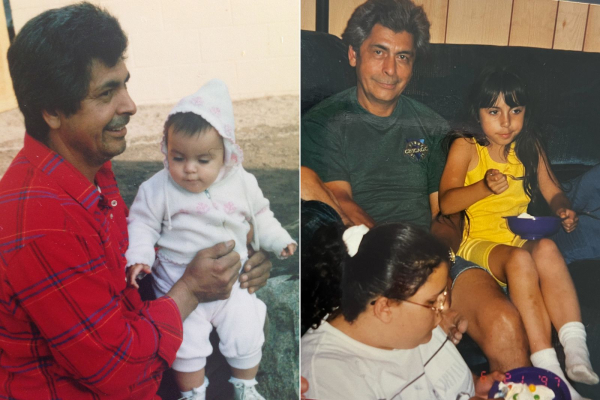
Samantha Leal and her father.
Courtesy Samantha Leal
That education continued when I interned at Latina in New York City under then-editor-in-chief Mimi Valdés, where conversations around Afro-Latina identity, colorism, language, and diaspora weren’t theoretical; they were foundational. It was one of the first times I saw Latinidad treated not as a monolith, but as an ecosystem of histories, contradictions, and migrations. Later, when I returned to the publication as deputy editor, I was for a long stretch the only Mexican American staffer—and the only one from a Mexican background, period—until an editorial assistant from my alma mater joined the team.
And yet, despite all these experiences that helped me grow confident as a Latina, I still carried a quiet insecurity: I never spoke Spanish. My father, like many Mexican Americans of his generation, had been punished for speaking it in school. Assimilation wasn’t framed as a choice for families like his; it was survival. The language stopped with him, even though the culture did not. Growing up, that absence often felt like a hole people expected me to apologize for, proof that I was somehow diluted or incomplete.
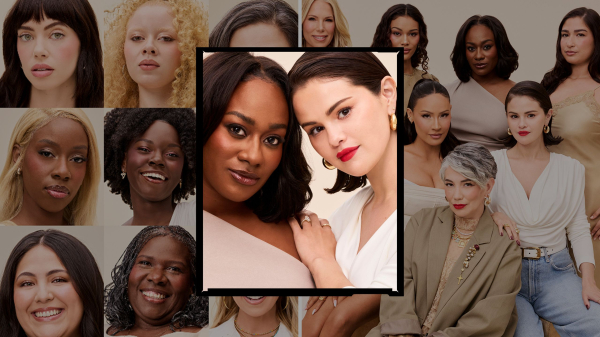
That’s why seeing Selena Gomez—who as a “half” Mexican grew up speaking Spanish but was heavily criticized last year for her American accent in Emelia Perez—plainly identify herself as Mexican American in Rare Beauty’s newest campaign hit me harder than I expected. The campaign, promoting the brand’s new “True to Myself Natural Matte Longwear Foundation” at Ulta Beauty, centers 48 Latina, Indigenous, and Afro-Latina women from across the Latin American diaspora, each paired with one of the line’s 48 shades. “48 shades. 48 stories. One community,” the campaign reads. Directed and photographed by Mexican and Costa Rican creative Brittany Bravo, with creative direction by Mexican creative Emily Angelica, video shot by Salvadoran cinematographer Jeffrey Ian, and photography by Mexican photographer Skylar Maio, the campaign feels intentionally built by Latine creatives both in front of and behind the camera.
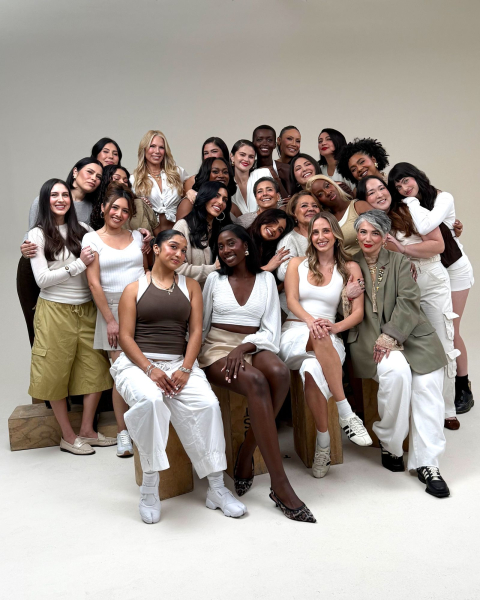 Courtesy Rare Beauty
Even the makeup artists, hairstylists, agency, and the studio itself were Latine-owned—details that matter, because they shape not just what we see, but who gets to shape the way we are seen. The visuals feel intimate and cool: women introducing themselves, speaking in their own cadences, carrying their own histories on their faces. Not over-complicated.
What struck me most was the campaign’s insistence on specificity. It’s not “Latina beauty,” flattened into some racially ambiguous ideal, but Latina identity in all its contradiction and breadth. Different skin tones. Different features. Different languages. Different relationships to heritage. Some women speak Spanish. Others may speak Portuguese, Garifuna, Indigenous languages, Spanglish, or none of their ancestral language at all. Some are first-generation; others have families that have been in the United States for generations. The campaign doesn’t attempt to collapse those differences into sameness. Instead, it treats them as the very thing that binds us.
The campaign doesn’t attempt to collapse our differences into sameness. Instead, it treats them as the very thing that binds us.
And Gomez’s participation feels especially meaningful because there is no over-explaining, no defensive qualifier, no performance of authenticity. Just a statement of fact: Mexican American. As someone who is also mixed—a “halfsie,” as I’ve often jokingly called myself, though I have never felt half of anything, only wholly made from multiple histories at once—I recognized immediately the relief in that kind of certainty. Gomez and I even share a similar lineage: daughters of Mexican American fathers from Texas, navigating what it means to inherit a culture that is both deeply rooted and constantly questioned. People like Gomez and me often exist in an in-between space, expected to constantly prove our connection to our culture while simultaneously being reminded, implicitly or explicitly, that we are only partially of it. In a political climate where Latines—especially brown Latines—are so often reduced to conversations about legality, immigration status, or “otherness,” there is something quietly radical about a beauty campaign insisting on our expansiveness instead.
In a political climate where Latines are often reduced to conversations about legality, immigration status, or “otherness,” there is something quietly radical about a beauty campaign insisting on our expansiveness instead.
Because the truth is, Latines in America occupy a strange cultural paradox: We are celebrated as flavor while scapegoated as people. Our music, beauty, slang, food, and “spiciness” are endlessly mined for aesthetics and influence, even as our communities are politicized and surveilled. We are visible everywhere and fully understood nowhere. And within our own communities, many of us are still navigating the question of legitimacy: brown enough, fluent enough, connected enough, Latina enough.
Rare Beauty’s campaign resonated because it acknowledged something larger than shade matching. It reflected the reality that Latinidad contains multitudes: Spanish speakers and non-speakers, Indigenous and Afro-Latines, mixed-race kids, immigrants, third-generation Americans, people who inherited culture fluently and people who inherited it in fragments. The point is not that we are all the same. It’s that we belong anyway.

Leave a Reply